What Perplexity Is (and Isn't)
Perplexity AI is an AI-powered research tool built around a single idea: every answer should come with sources. When you ask a question, it searches the web in real time, synthesises the results into a coherent answer, and attaches numbered citations to every claim. You can click any citation to see exactly where the information came from.
This makes Perplexity genuinely excellent at sourced research. Perplexity offers two tiers of search: basic searches use a lighter model for quick cited answers, while Pro Searches use more powerful models with multi-step reasoning and deeper source analysis. Focus modes narrow searches to specific domains -- Academic, Writing, Math (Wolfram Alpha), Video/YouTube, Social/Reddit, and Finance (SEC filings, stock data). All users, including free accounts, can access Focus modes.
Deep Research, launched early 2025, is Perplexity's most powerful capability. It conducts autonomous multi-minute investigations: dozens of parallel searches, hundreds of sources, and comprehensive cited reports. It scored 93.9% on the SimpleQA benchmark and is available to all users with daily limits. Spaces let you organise research into persistent, collaborative workspaces with file uploads, custom AI instructions, preferred models, and team access.
If you've ever wasted time chasing down a claim only to find it was made up by an AI — you'll appreciate why Perplexity's citation model matters, even with its imperfections.
Where Perplexity is less distinctive: its core strength remains sourced research, not open-ended generation. Source quality varies -- blogs and forums are cited alongside peer-reviewed research without distinction. Responses can feel formulaic when you want original thinking rather than a summary of existing content. Capabilities are expanding: Pro users can select frontier models, and Perplexity Computer (Max plan only, launched February 2026) adds a general-purpose digital worker orchestrating multiple AI models. But dedicated tools remain stronger for complex creative writing and development work.
No account is needed for basic use. The free tier gives unlimited basic searches, roughly 5 Pro Searches per day, and limited Deep Research queries. Pro ($20/month or $200/year) provides unlimited Pro Searches, more Deep Research, file uploads (PDFs, documents, images, audio, video -- up to 50MB per file), and model selection -- though in practice, heavy usage may hit undisclosed rate limits. Max ($200/month or $2,000/year) provides truly unlimited Pro Searches, the latest frontier models, and Perplexity Computer.
⚖️ Perplexity Free vs Pro
Tier Features Price Perplexity Free ~5 Pro Searches/day, basic model, limited file upload (3 files/day, 5MB each) $0/month Perplexity Pro Unlimited Pro Searches, all models, file upload (50MB), $5/month API credits $20/month
Get Started
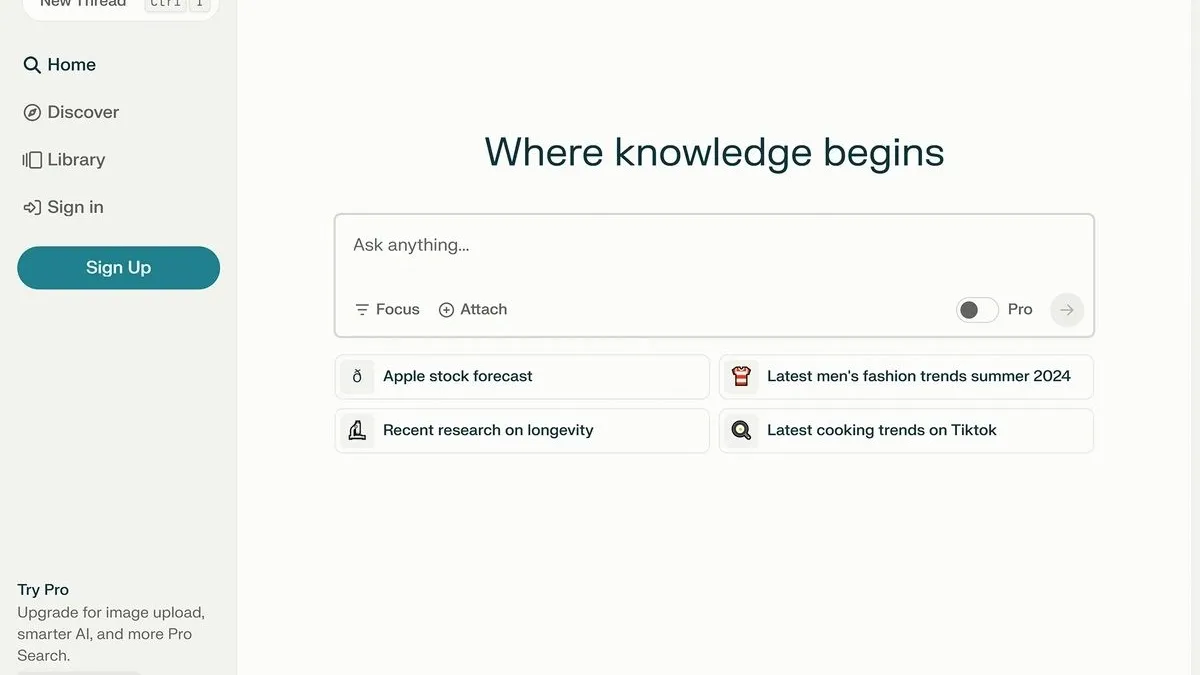
Open perplexity.ai. No account required, though signing in unlocks history and Spaces. Type this prompt:
What are the three most significant developments in renewable energy this week? For each one, explain why it matters and cite the original reporting.
If your first search returned impressive-looking citations that you didn't bother to click — that's the habit this entire path is designed to change.
Notice three things:
- Numbered citations -- click at least one to verify it leads to a real article supporting the claim.
- Recency -- check whether the developments are genuinely from this week.
- Synthesis quality -- Perplexity should combine multiple sources into a coherent narrative, not list disconnected facts.
Core Skill 1: Research with Citations
Citations are not a bonus feature -- they are the entire point. We learned this the hard way: early on, we cited a Perplexity result in a client report without clicking the source link. The article didn't say what Perplexity claimed it did. That one mistake changed how we use every AI research tool.
The key principle: prompt for the kind of sourcing you need. A vague question gets vague citations. A specific question -- with a time window, domain, or explicit request for primary sources -- produces references you can actually use.
What peer-reviewed research has been published in the past 12 months on the long-term health effects of intermittent fasting? Prioritise clinical trials and meta-analyses over opinion pieces.
For complex questions, use Deep Research instead of a standard Pro Search -- Perplexity will spend several minutes conducting dozens of parallel searches and produce a comprehensive cited report.
When citations are reliable
Last verified: March 2026
- Well-covered current events -- multiple reputable outlets reporting the same facts
- Government and institutional data -- statistics from official bodies, published reports
- Established scientific findings -- widely cited research with clear publication records
- Product and company announcements -- press releases, official blogs, earnings reports
When citations need scrutiny
Last verified: March 2026
- Niche or emerging topics -- fewer sources means Perplexity may cite low-quality blogs or forums
- Contested claims -- may cite one side of a debate without flagging disagreement
- Statistics without methodology -- a cited number may come from a source that itself lacks rigour
- Paywalled content -- may cite an article based only on its headline, not the full text
📈 Perplexity Citation Reliability by Source Type
Source: AI Tutorium internal testing, March 2026
Knowledge Check
You're writing a report and Perplexity returns a statistic with a numbered citation. What should you do FIRST?
Exercise: Sourced Fact-Check
Scenario: A colleague claims a country recently banned a particular technology. You need to verify this before including it in a report.
Task: Prompt Perplexity:
Has the European Union banned any specific applications of artificial intelligence in the past 90 days? Provide the exact regulation name, the date it came into effect, what it prohibits, and link to the official source.
What to observe: Does it find a real regulation with a verifiable source, or give vague language about "proposed" legislation? Click through to at least two citations and check whether the sources say what Perplexity claims.
Exercise: Literature Review Starter
Task: Choose a topic relevant to your work. Switch to Academic Focus mode, then prompt:
Give me a research overview of [your topic] based on sources from the past two years. Identify the three most-cited findings, name the key researchers or institutions, and provide links to the original publications.
What to observe: Are the researchers real? Do the links work? Is Perplexity distinguishing between primary research and secondary commentary?
Core Skill 2: Focus Modes and Search Strategy
Focus modes change where Perplexity searches. All users can access them.
Last verified: March 2026
- Web (default) -- full web. Best for general questions and current events.
- Academic -- scholarly databases and papers. Best for research-backed claims.
- Writing -- composition assistance without web search.
- Math -- Wolfram Alpha-powered problem-solving with step-by-step reasoning.
- Video/YouTube -- video platforms. Best for tutorials and visual explanations.
- Social/Reddit -- forums and discussions. Best for real user experiences.
- Finance -- SEC filings, stock data, earnings reports. Best for company and market analysis.
Note: On the web interface, Focus modes are accessed via the "+" menu next to the search bar. Mode names and locations may vary between web and mobile.
The most common mistake is leaving Perplexity on Web mode for everything. Academic mode surfaces papers that general search buries beneath news articles. Finance mode pulls structured data from regulatory filings that general search misses. The second mistake is using Perplexity when you do not need web search -- for pure drafting tasks, a dedicated assistant may do better.
📈 Focus Mode Accuracy by Category
Source: AI Tutorium internal testing, March 2026
Knowledge Check
Your manager asks you to find real user opinions about a new project management tool your team is evaluating. Which Focus mode should you use?
Exercise: Mode Comparison
Task: Run the same query in Web mode, then Academic mode:
What does the current evidence say about the effectiveness of four-day work weeks on productivity and employee wellbeing?
What to observe: How different are the sources? Does Academic mode cite published studies while Web mode cites news articles? Which would you trust more for a formal report?
Exercise: Community Knowledge
Task: Pick a product you are considering. Switch to Social mode and prompt:
What are real users saying about [product/tool] in the past 6 months? Common praises, complaints, and recurring issues?
What to observe: Does Social mode surface Reddit threads and forum posts? Are the perspectives more candid than professional reviews? What did Perplexity miss that you would want to check directly?
Core Skill 3: Deep Research and Iterative Investigation
Perplexity offers two approaches to in-depth research: the follow-up system for iterative manual drilling, and Deep Research for autonomous investigation.
The follow-up system lets you ask questions that build on previous context, turning a single query into a research thread. The principle: start broad, then narrow. Deep Research automates this -- Perplexity autonomously plans a strategy, runs dozens of parallel searches, reads hundreds of sources, and compiles a comprehensive cited report. A single query can replace many manual follow-ups.
Spaces organise research threads across sessions. You can upload files (PDFs, documents, images, audio, video), set custom AI instructions, choose preferred models, and invite collaborators.
When should you use Deep Research instead of a regular Pro Search with follow-ups?
Deep Research is best when you need comprehensive coverage of a complex topic across many sources -- it autonomously runs dozens of parallel searches and synthesises hundreds of sources into a single cited report. Use regular Pro Search with follow-ups when you want to steer the investigation manually, drilling into specific angles as you discover them. Think of Deep Research as "cast a wide net automatically" versus follow-ups as "I'll choose where to dig next."
Exercise: The Three-Layer Drill
Task: Choose a topic you know little about. Build a three-layer research thread:
Layer 1: What is [topic] and why is it significant right now? Essential context with sources.
Layer 2: Tell me more about [specific aspect from Layer 1]. Key debates or open questions?
Layer 3: Based on everything above, practical implications for [your specific context]?
What to observe: Does each layer build on the previous one? Then try the same topic with Deep Research in a single query and compare the coverage.
Exercise: Organised Research Project
Task: Create a new Space for a multi-day research project. Over two or three sessions, build at least three threads covering different angles. Upload relevant documents so Perplexity can reference them alongside web sources.
Thread 1: [Broad overview question]
Thread 2: [Specific technical or practical question]
Thread 3: [Counterarguments, risks, or alternative perspectives]
What to observe: Does the Space give you a useful overview when you return? Would sharing it give a colleague a useful introduction to the topic?
Exercise: Deep Research Critical Investigation
Deep Research can feel authoritative — a multi-minute investigation citing dozens of sources looks impressively thorough. This exercise builds the habit of questioning that thoroughness rather than trusting it.
Task:
- Pick a nuanced topic where sources are likely to disagree — for example, "Is remote work more productive than office work?" or "What are the long-term health effects of intermittent fasting?"
- Run Deep Research in Perplexity and let it generate the full report.
- Evaluate the report critically. Work through these questions:
- How many unique sources were cited? Are we looking at 8 or 80?
- Are sources from authoritative outlets (peer-reviewed journals, major publications, government data) or mostly blogs and forums?
- Do any sources contradict each other? How does Perplexity handle the disagreement — does it acknowledge it, or quietly side with one view?
- What perspectives or evidence types are missing? (For health topics: were clinical trials cited? For workplace topics: were employee surveys included alongside employer studies?)
- Click through to at least 3 cited sources and verify the claims. Does the source actually say what the report attributes to it?
- Write a 2-sentence "confidence assessment" — how much would you trust this report if you needed to make a real decision based on it?
What to observe: Most people find that Deep Research reports look more reliable than they are. If your confidence assessment is lower than your initial impression — that gap is exactly the critical thinking muscle this exercise is designed to strengthen.
Core Skill 4: Evaluating Perplexity's Sources
If you've been trusting Perplexity's citations without checking them, you're in good company — the numbered sources create a powerful illusion of reliability. Perplexity's citations create a dangerous illusion: because every claim has a numbered source, the response feels more trustworthy than an unsourced AI answer. But Perplexity does not evaluate source quality -- it searches, finds, cites, and moves on. The evaluation is your job.
Source evaluation framework
- Does the source exist? Click the link. Perplexity occasionally generates plausible URLs that lead nowhere.
- Does it say what Perplexity claims? Perplexity sometimes paraphrases loosely or draws unsupported conclusions.
- Is it credible? A government report and a personal blog are not equivalent. Perplexity treats them the same.
- Is it current? Perplexity may present older content as recent if newer sources are unavailable.
Common failure patterns
- Circular sourcing -- citing an article that itself cites another AI-generated summary
- Headline sourcing -- citing a paywalled article based only on its headline
- Majority-rules synthesis -- siding with five low-quality sources over one high-quality dissenter
- Missing the best source -- the most authoritative source might not rank well in web search
Why is "majority-rules synthesis" a dangerous failure pattern in Perplexity?
Perplexity weighs sources by quantity, not quality. If five blog posts repeat the same incorrect claim and one authoritative source contradicts it, Perplexity will likely side with the majority. This is especially dangerous for contested topics where misinformation is widely repeated -- the sheer number of low-quality sources can drown out the single credible dissenter.
Exercise: Source Audit
Task: Ask Perplexity about recent developments in your field. Request at least five specific claims with source links and dates. Audit every citation: Does the link work? Does the source support the claim? What type of source is it? How recent is it really?
Reflection: What percentage fully check out? What is your personal trust threshold for Perplexity citations?
Exercise: Bias Detection
Task: Choose a topic where reasonable people disagree. Prompt:
What are the main arguments for and against [topic]? Cite the strongest source for each position.
What to observe: Does Perplexity give balanced coverage? Are sources on each side of comparable quality? Does it give more favourable framing to one position?
Challenge Exercises
These combine multiple skills and require judgement. Each simulates a scenario where research quality matters.
Challenge 1: The Verified Briefing
Prepare a one-page briefing on a real topic. Research across at least two Focus modes (e.g., Web + Academic). Try both a Pro Search thread and a Deep Research query. Every claim in your final briefing must include a citation you have personally clicked through and confirmed.
Success criteria: Someone could check every source and find each one real, current, and supportive of the claim attached to it.
Challenge 2: Source Quality Comparison
Spend 15 minutes researching a factual question manually using Google Scholar and primary sources. Then ask Perplexity the same question using both a standard Pro Search and Deep Research. Compare: Which found better sources? Which was faster? When does manual research win?
Success criteria: You can articulate when Perplexity saves time, when Deep Research outperforms standard search, and when manual research produces better results.
Challenge 3: The Research Handoff
Use Perplexity Spaces to build a research package. Create at least three threads covering different angles, upload relevant documents, verify key citations, and write a summary of findings and open questions. Share the Space with a colleague.
Success criteria: Your colleague could open the Space, understand the current state of knowledge, and continue research without duplicating your work.
Quick Reference
Prompting Patterns That Work
- Time-bounded: "In the past [timeframe], what has happened with [topic]? Cite the original reporting."
- Source steering: "Prioritise peer-reviewed research / government data / primary sources over commentary."
- Multi-perspective: "What are the main positions on [topic]? Cite the strongest source for each side."
- Iterative drilling: Start broad, then "Tell me more about [specific aspect]."
- Verification: "Is [claim] accurate? Find the primary source that confirms or contradicts it."
- Mode-specific: Academic for scholarly work, Social for user experiences, Finance for market data.
- Deep Research: Use for complex questions requiring comprehensive multi-source coverage.
Perplexity's Strengths
Last verified: March 2026
- Transparent, numbered citations on every claim
- Real-time web search with current information
- Deep Research for autonomous, comprehensive multi-source investigation
- Focus modes for domain-specific research (Academic, Finance, Social, Video, etc.)
- Spaces for organised, collaborative research with file uploads and custom instructions
- Model selection (Pro/Max) -- choose from frontier models for different tasks
- File upload and analysis -- PDFs, documents, images, audio, and video (limited on free; up to 50MB per file on Pro and above)
- Follow-up questions for iterative research deepening
Perplexity's Limitations
Last verified: March 2026
- Core strength remains sourced research -- expanding via Perplexity Computer (Max only), but dedicated tools still stronger for complex creative writing and development
- Source quality varies -- cites blogs alongside peer-reviewed research without distinction
- Can fabricate plausible-sounding citations that do not check out
- Over-reliant on web sources -- struggles when the best answer is not published online
- May present older information as current when recent sources are scarce
- Pro Search is marketed as unlimited on Pro, but undisclosed rate limits may apply under heavy usage -- Max plan guarantees truly unlimited access
Source Verification Checklist
- Does the citation link lead to a real, accessible page?
- Does the source actually say what Perplexity claims?
- Is the source a credible authority on this topic?
- Is the publication date genuinely recent, or is older content presented as current?
- Are multiple independent sources supporting the claim, or is it single-sourced?
If you can work through this checklist consistently, you're building a verification instinct that will serve you well beyond Perplexity — across every AI research tool you use next.
Practice Project
You've learned to search, verify, and dig deeper. Now let's use all of that to produce something you can actually hand to someone — a research brief that's genuinely useful and properly cited.
Research Brief
Time: 45-60 minutes
What you'll build: A cited 1-page intelligence brief on a real topic you need to understand — researched entirely through Perplexity, verified against sources, and polished enough to share with colleagues.
Why this matters: Research without a deliverable is just browsing. The discipline of producing a brief — something concise, cited, and useful to someone else — forces you to move beyond "interesting" to "actionable." We've found that the process of writing a brief exposes exactly where your understanding is solid and where it's still fuzzy. It's the fastest way to go from "I sort of know about this" to "I can brief my team on this in 5 minutes."
Steps
- Choose a real topic you need to understand. Pick something relevant to your work or a decision you're facing — a technology your team is evaluating, a market trend affecting your industry, a regulatory change, or a competitor's new strategy. The topic should be specific enough that a 1-page brief makes sense, not so broad that it needs a book. Write down the 3 questions your brief needs to answer for it to be useful to you or your team.
- Research with Perplexity using the techniques from this path. Start with a Pro Search to get an overview, then drill down with follow-up questions on each of your 3 key questions. Use Focus modes where relevant — Academic for research-backed claims, Finance for market data, Social for public sentiment. For each significant claim, click the citation to verify the source exists and says what Perplexity claims. Flag any citations that don't check out. Aim for 4-6 high-quality sources that cover your 3 questions from different angles.
- Write your 1-page brief. Structure it as: a 2-3 sentence executive summary at the top, then 3 short sections (one per key question), each with 2-4 sentences and at least one cited source. End with a "So What" section — 2-3 sentences on what this means for your team or decision. Keep the total under 500 words. Write in your own words, not Perplexity's. The citations give it credibility; your analysis gives it value.
- Quality-check with the verification checklist. Run every citation through the Source Verification Checklist from this path. Replace any that fail. Read the brief once as if you're the recipient — does it answer the questions that matter? Does it distinguish between well-supported claims and speculative ones? Revise anything that feels like it's padding rather than insight.
Deliverable: A 1-page intelligence brief (under 500 words) with an executive summary, 3 key findings with citations, and a "So What" section — ready to share with a colleague or manager.
Stretch goal: Try Perplexity's Deep Research mode on the same topic and compare the output to your manually crafted brief. What did Deep Research find that you missed? What did your human judgement catch that the automated report glossed over?
Reflection: How many of your original citations survived verification? If it was fewer than you expected, that's not a failure — it's proof that your verification instinct is working. The brief you've produced is more trustworthy than 90% of AI-generated content precisely because you checked.
You've just produced something most people can't: a concise, cited, verified research brief built in under an hour. That's a skill with a long shelf life — regardless of which research tools come next.