Here is what most people's AI journey looks like. You start by using it to speed up things you already do — drafting emails faster, summarising documents in seconds, brainstorming ideas more quickly. And that is genuinely useful. Saving 30 minutes on a weekly report feels like progress. But at some point, a quiet thought creeps in: "Is this it? Am I just doing the same work slightly faster?"
That feeling is not disappointment — it is a signal. It means you have learned the efficiency layer and you are ready for something bigger. The most exciting thing about AI is not that it helps you do old things faster. It is that it lets you create things you could not have created before — new solutions, new products, new approaches that were previously out of reach because you lacked the time, the skills, or the resources.
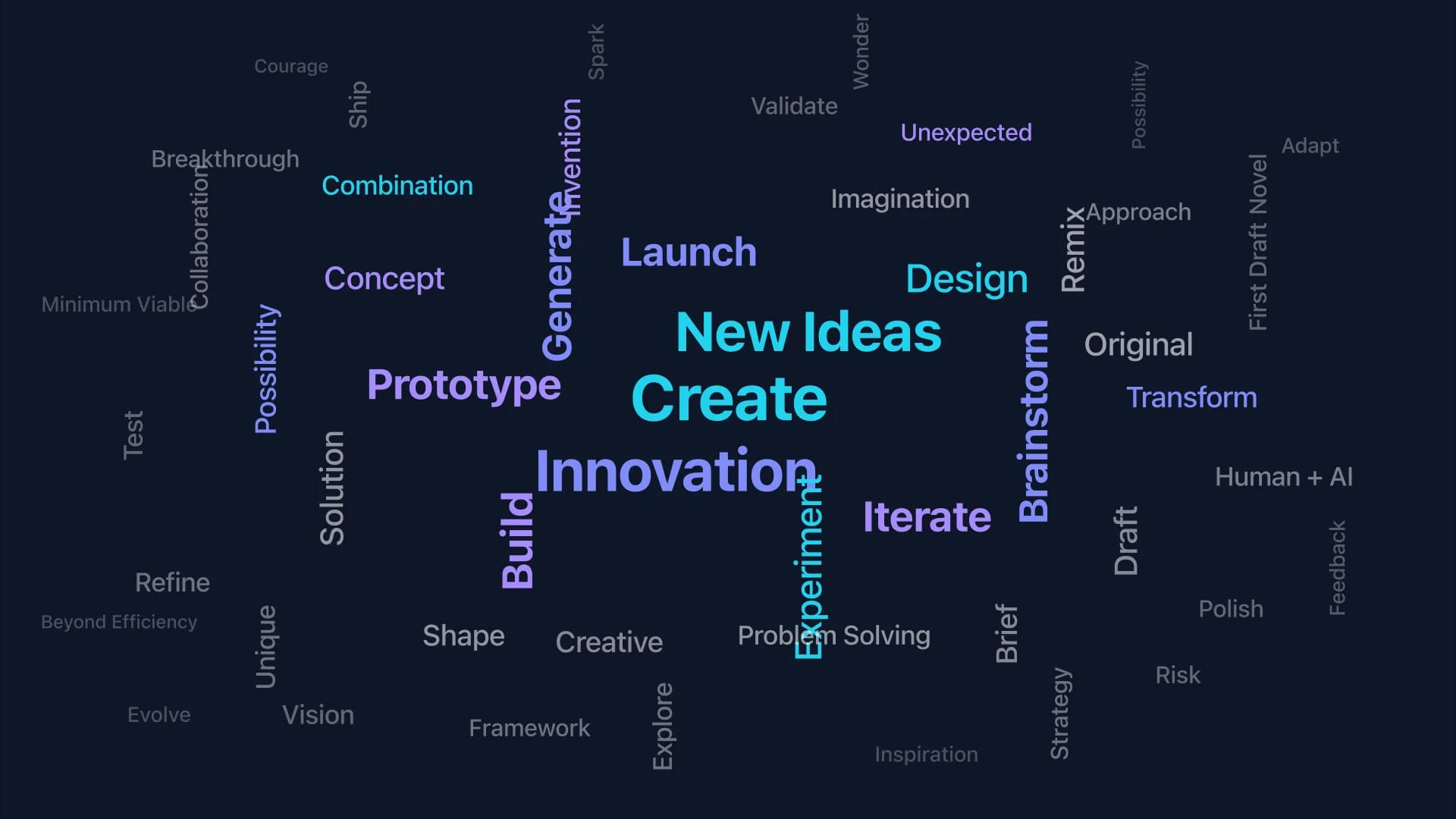
This is what we call the "Create" pillar of the ICE Method — using AI to produce something that did not exist before, solving problems or delivering value in entirely new ways. And it is, honestly, where the real magic lives.
The Efficiency Trap
Let us be direct about something we got wrong ourselves for a long time. When we first started using AI tools, we measured their value entirely in time saved. "That email used to take 15 minutes, now it takes 3 — brilliant." And it was brilliant, genuinely. But after a few months, we realised we had optimised our way to a ceiling.
The efficiency trap works like this: you use AI to do your existing tasks faster, you fill the saved time with more of the same tasks, and your work becomes higher-volume but not fundamentally different. You are running on the same track, just quicker. Your role has not changed. Your capabilities have not expanded. And the competitive advantage you gained from speed disappears the moment everyone else starts doing the same thing — which, given how fast AI adoption is moving, does not take long.
This is not a criticism of using AI for efficiency. The "Improve" pillar — doing what you already do, faster and better — is valuable and often the right place to start. But it is chapter one. The story gets much more interesting in chapter two.
Research Callout: McKinsey's State of AI research found that organisations pursuing transformational AI use cases — creating new products, processes, and revenue streams — were significantly more likely to report high value from AI than those focused purely on cost reduction. The pattern holds at the individual level too: professionals who use AI to build new things tend to feel less anxious about AI replacing their roles.
What "Create" Actually Means
When people hear "use AI to create," they often think of art. AI-generated images, music, video. And yes, that is part of it. But creative use of AI extends far beyond artistic outputs. Here is a broader — and, we think, more useful — way to think about creation.
New processes. You notice that your team spends three days each quarter preparing a client review. You use AI to build a semi-automated workflow: it pulls key metrics, drafts the narrative sections, generates visualisations, and produces a first draft that your team can refine in two hours instead of three days. That process did not exist before. You created it.
New products or services. You run a small consultancy and your clients keep asking for industry benchmarks. You use AI to analyse publicly available data, generate comparison reports, and create a self-service benchmarking tool that clients can use between consulting engagements. A new revenue stream, built with AI as the engine.
New content formats. You have been writing blog posts for years. Using AI, you transform your written content into interactive quizzes, personalised learning paths, audio summaries, or visual infographics — formats your audience responds to that you never had the skills or time to produce before.
New solutions to old problems. Your customer support team has a knowledge base that nobody reads because it is 400 pages of dense text. You use AI to build a conversational interface that answers customer questions in plain language, pulling from the knowledge base but making it actually accessible. Same information, entirely new way of accessing it.
New ideas that compound. A children's book you wrote with AI's help for your daughter's birthday. A personalised onboarding guide for new hires that adapts based on their role. A competitive intelligence dashboard that refreshes weekly. Each of these is something that generates ongoing value, not a one-time time saving.
The thread connecting all of these is the same: you used AI not to do an existing task faster, but to build something that was not there before. Something that adds value in a new way.